
Reviewed · MUSEUMS
Paris: Jewish Quarter & Museum of the Art and History Tour
Paris’s Jewish story is written into the streets of Le Marais: in its synagogues, kosher shops and bookshops, and in the memorial that recalls the French Jews deported during World War II. This private tour links those places with the guide’s account of centuries of expulsion, emancipation and community life. I especially like the contrast between the working neighborhood and the solemn Deportation Martyrs Memorial.
The other strong point is choice: a two-hour walk keeps the focus on the quarter, while the longer options add the Museum of the Art and History of Judaism, and the 5.5-hour version includes car transfers. One caution: the shortest tour does not include museum admission, and a past booking ran into confusion about the start time and meeting spot. Confirm both before you set out.
Key points to know before you book
- Le Marais is the heart of the walk: Expect Jewish shops, bookshops, kosher restaurants and two landmark synagogues.
- The memorial adds a sober stop: On Île de la Cité, the Deportation Martyrs Memorial focuses the tour on the Holocaust and its impact on French Jews.
- The museum requires a longer option: The four-hour and 5.5-hour tours include skip-the-line tickets to the Museum of the Art and History of Judaism.
- The 5.5-hour option includes a car: Private transfers to and from your Paris accommodation are part of this version.
- It is a private tour: You choose from several guide languages, and the pace and questions are for your group.
- Be precise about the start: The stated meeting point is in front of the Statue d’Étienne Marcel. Check your email the day before and arrive on time.
A walk through Jewish Paris, not just a museum visit
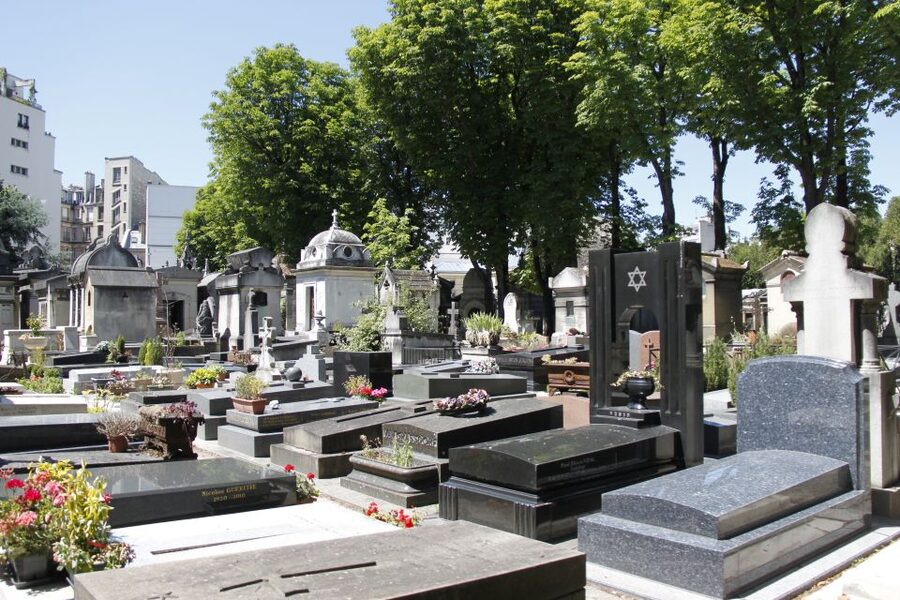
This experience is best understood as a guided walk through a neighborhood with a long, often difficult history. Le Marais is now a fashionable part of Paris, but its Jewish life is not simply a relic of the past. Shops, bookshops and kosher restaurants remain part of the everyday streetscape, giving you a chance to see the community’s presence alongside the historic sites.
Your guide connects those visible details to broader changes in French Jewish life. The tour’s historical frame reaches from the First Crusade and the French Wars of Religion through the French Revolution and into the Holocaust. That sweep matters: it gives you context for why the community’s story includes both periods of persecution and moments of emancipation.
Because it is a private group, you can ask questions as they come up rather than waiting for a general explanation to finish. The guide is described as a Jewish history specialist, and the strongest praise for the experience centers on the guide’s command of the subject. That expertise is especially useful here, where a synagogue façade or memorial can be easy to pass without knowing what it represents.
The tour is offered in English, German, French, Italian, Spanish, Russian and Polish. Choose the language that will let you follow the history comfortably, particularly if you plan to ask detailed questions.
More museum visits in Paris:
- Paris: Louvre Museum Timed-Entrance Ticket
★ 4.6 · 71,977 reviews - Paris: Orsay Museum Entry Ticket
★ 4.7 · 25,647 reviews - Louvre Museum Masterpieces Guided Tour with Access
★ 4.5 · 12,023 reviews
Starting near Hôtel de Ville
The meeting point is in front of the Statue d’Étienne Marcel at 1341 Quai de l’Hôtel de ville. The itinerary also describes the Courtyard of the Hôtel de Ville as the starting point, so use the exact meeting details sent before the tour rather than relying on a general map search for Hôtel de Ville.
This is a useful place to begin a story about civic power and changing rights. From here, your guide introduces the history of expulsions and emancipation, including the shifts in Jewish life across the First Crusade, the French Wars of Religion and the French Revolution. The aim is not to treat those events as a list of dates, but to set the neighborhood’s later growth in context.
The tour then heads toward Île de la Cité, the island best known for Notre-Dame Cathedral. The principal Jewish-history stop here is the Deportation Martyrs Memorial, which commemorates people sent to Nazi concentration camps during World War II. It is a solemn counterweight to the street-level scenes of shops and cafés elsewhere on the route.
Expect this part to be reflective rather than a sightseeing stop built around a grand view. The memorial’s value is in the guide’s explanation of what happened to French Jews during the Holocaust and how the community rebuilt afterward. If you prefer a tour with only light historical themes, this is not that. The subject is central to the experience.
Finding Jewish life in Le Marais
From the memorial, the route explores Le Marais, the old Jewish quarter. After the French Revolution, the area developed into an active commercial district and became home to one of Paris’s main Jewish communities. Today, the mix of Jewish shops, bookshops and kosher restaurants gives the walk a lived-in quality that a sequence of monuments alone could not provide.
I like this balance between history and present-day life. You are not only hearing what happened in the past; you are also seeing where Jewish culture and businesses remain part of the neighborhood. The tour does not promise entry to every site, though, so think of it as an interpretive walk rather than a comprehensive visit inside each synagogue.
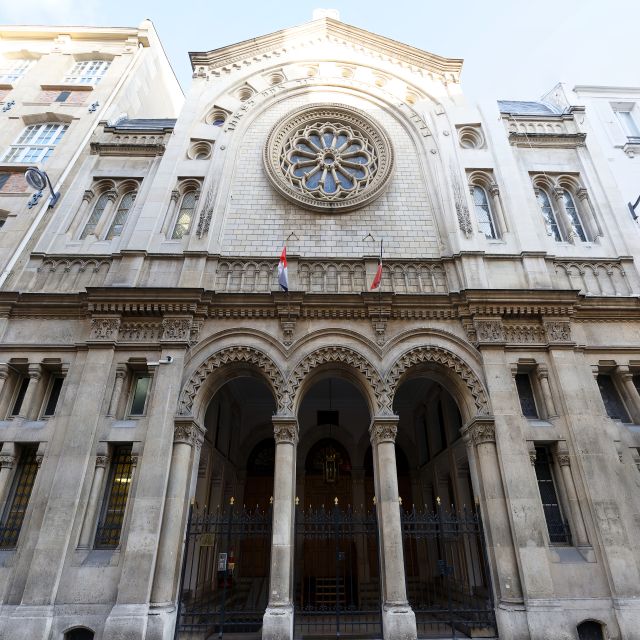
One of the architectural highlights is the Agoudas Hakehilos Synagogue. It was built in the early 1900s by a wealthy group of Orthodox Jews who had immigrated from Poland and Russia. That detail ties the building to migration and community formation, not just to a style or date.
The Synagogue des Tournelles is another stop, near Place des Vosges, Paris’s oldest planned square. The synagogue offers a different point of interest from the surrounding streets, while Place des Vosges gives you a sense of the district’s urban setting. The tour describes these as heritage sites to see, so do not assume that every synagogue visit includes entry.
The route’s appeal lies in the connections your guide makes between the buildings, migration and the neighborhood’s changing role. If you are hoping for a long stretch inside religious sites, ask in advance what access is planned. The supplied itinerary emphasizes seeing synagogues and heritage locations, not guaranteed interior visits.
Choosing the museum extension
The four-hour option adds the Museum of the Art and History of Judaism, with skip-the-line tickets. This is the right choice if you want more than a neighborhood overview and would like time with objects, documents and artworks that place Jewish culture in a broader European and North African context.
Outside the museum, you will see a statue of Alfred Dreyfus, the French Jewish officer convicted of treason in 1894. His case is a significant marker in the history of antisemitism and French public life, and it provides a clear link between the tour’s street history and the museum’s wider story.
Inside, the permanent and temporary exhibitions include religious objects, archives, manuscripts and works of art. The collection includes paintings by Marc Chagall and Amedeo Modigliani. For a visitor with limited time in Paris, this museum adds texture that the walking route cannot: material culture and art offer another way to understand Jewish traditions and communities.
The museum extension is not included in the basic two-hour tour. That distinction is easy to miss when comparing options, so check that your selection specifically includes museum tickets. Skip-the-line access is included in the four-hour and 5.5-hour versions, not the shortest one.
The four-hour choice is a sensible middle ground if you want both the neighborhood and the museum but do not need a car transfer. It does, however, make for a substantial history-focused outing. If your Paris schedule is already packed, the two-hour walk may be easier to fit in, with the trade-off that you will miss the museum’s collections.
More history tours in Paris:
- Paris: Louvre Museum Entry with History of Mona Lisa
★ 3.9 · 2,823 reviews - Paris: Dark History and Ghostly Guided Walking Tour
★ 4.7 · 1,000 reviews - Le Marais/Paris – The Historic, Trendy, Jewish, LGBT district
★ 5.0 · 341 reviews - Paris City of Fashion History Private Guided Walking Tour
★ 5.0 · 221 reviews
When private transport is worth the extra time
The 5.5-hour option combines the Old Jewish Quarter walk, the museum visit and private car transfers from your accommodation. The vehicle is described as clean and air-conditioned, with a professional driver handling pickup and drop-off.
That convenience is most useful if you would rather not manage the trip to the meeting point yourself, or if a longer outing would be easier with a ride at either end. It does not change the core walking and museum content, but it makes the day more contained. You still need to be ready at the agreed pickup time, and the tour’s key historical stops remain on foot.
For a couple or small private group choosing between the four-hour and 5.5-hour versions, the question is less about adding another attraction and more about convenience. If you are comfortable making your own way to and from the tour, the four-hour option already includes the museum. If door-to-door transport matters, the longer version may justify the added time and cost.
Is $200 per person good value?
The stated price is $200 per person, but the exact value depends on the duration and option you select. The tour is private, includes a specialist guide, and, on the two longer versions, includes skip-the-line museum tickets. The longest option also includes private transfers. Those inclusions make the price easier to justify if you want tailored explanations and a full, organized outing.
The two-hour walk is the leanest choice. You pay for a private guide and a focused route through the quarter, but museum admission and transport are not included. It is best value if the walking tour itself is your priority and you want a direct introduction to Jewish Paris without committing half a day.
At four hours, you add a substantial museum visit and skip-the-line entry. That is likely the strongest balance for anyone interested in both the neighborhood and Jewish art and history. The 5.5-hour option adds private transport, which can be worthwhile if pickup and drop-off are important to you, but less compelling if you are already comfortable getting around Paris.
There are only a small number of ratings available, so I would not treat the overall score as a firm measure of consistency. The most useful practical lesson is to pin down the start time and meeting point. One account describes confusion on both, as well as a tour that saw fewer sights than expected and did not include the museum. Since the museum is included only in the longer options, check your selected duration and confirm the plan rather than assuming it is part of every tour.
Who will get the most from this tour?
I would choose this tour if you want a guided account of Jewish Paris that connects community life, architecture and the Holocaust. It suits visitors who value context and conversation more than a checklist of interiors. The private format is especially helpful if you have questions or want to move at a pace that works for your own group.
Choose two hours if you want a compact neighborhood walk. Pick four hours if the museum matters to you. Choose 5.5 hours if you want the museum and private car transfers together.
This is also a useful option for anyone who has already seen Paris’s major landmarks and wants to understand another layer of the city. Just keep expectations clear: the route includes important sites, but the available details do not promise entry into every synagogue, and only the extended tours include the museum.
Before booking, compare the duration and inclusions, then check your email the day before for the final meeting information. Arrive on time, since some attractions have reserved entry slots and a late start may cut into the experience.
FAQ
Where does the tour start?
The stated meeting point is in front of the Statue d’Étienne Marcel at 1341 Quai de l’Hôtel de ville, 75004 Paris. Check your email the day before for important details.
How long does the tour last?
Options run from two to 5.5 hours. The four-hour option adds the museum, and the 5.5-hour option includes the museum and private car transfers.
Is the Museum of the Art and History of Judaism included?
It is included in the four-hour and 5.5-hour options, with skip-the-line tickets. It is not included in the basic two-hour tour.
Does the tour include private transportation?
Private car pickup and drop-off from your Paris accommodation are included only in the 5.5-hour option. They are not included in the two- or four-hour options.
Which languages are available?
The guide is available in English, German, French, Italian, Spanish, Russian and Polish.
Is the tour private?
Yes. It is offered as a private group tour.
Is the tour wheelchair accessible?
Yes, the activity is listed as wheelchair accessible.
Recently reviewed in Paris
- Private Paris WWII History Tour: Occupation & Resistance★ 4.4 · 3 reviews
- Private Highlights of Paris Bike Tour★ 4.9 · 12 reviews
- Paris: Louvre Museum Highlights Small-Group Guided Tour★ 4.8 · 157 reviews
- Private Orsay Museum Tour: 2h Highlights w/ Monet & Van Gogh★ 5.0 · 4 reviews
- Private Mont Saint-Michel trip from Paris Calvados tasting★ 5.0 · 4 reviews
- Highlights of Paris: Private 6-Hour Vintage 2CV Tour★ 3.9 · 19 reviews
- Private Giverny Monet’s House & Gardens Trip from Paris★ 4.9 · 11 reviews
- Private Guided Tour, The Louvre by night !★ 4.2 · 30 reviews
Museums, compared.
Louvre Museum Masterpieces Guided Tour with Access
Read our review →
Louvre Museum Entry Ticket With Host and River Cruise
Read our review →
Les Invalides: Napoleon’s Tomb & Army Museum Entry
Read our review →
Louvre Museum – Exclusive Guided Tour (Entry Included)
Read our review →
Louvre Museum Hosted Entry and Mona Lisa Audioguide
Read our review →
Louvre Museum Tour Mona Lisa & Iconic Masterpieces
Read our review →Browse the lists this tour appears in